15 Effective Communication and Stakeholder Management
Acknowledgements
Perplexity and Gemini were used for identification and summarization of sources cited in these notes.
Crafting Communications for Different Audiences
Tailoring your message to ensure it resonates with the recipient, whether they are deeply technical or executive-level (Kirkendoll 2024; Management 2025)
Understand your audience and goal
What do you need the audience to know, do, or decide?
Audience profile: Identify their level of
- Technical knowledge
- Interest
- Influence
Technical audience communication
- Focus
- Accuracy
- Detail
- Methodology
- Data/metrics
- Challenges
- Format
- Detailed reports
- Architecture diagrams
- Code snippets
- Jira updates or GitHub Issues
- Stand-up summaries
- Language: Use precise technical jargon when appropriate to maintain credibility and speed
Executive Audience Communication
- Focus
- Impact
- Status (RAG - Red/Amber/Green)
- Cost
- Risk
- Next steps
- Format
- Executive summaries
- Dashboards
- High-level presentations (3-5 key slides)
- Language
Business-oriented language
Focus on the “so what” (i.e. how the technical work impacts the bottom line, revenue, or strategic goals)
Follow the pyramid principle
- Start with the answer/conclusion (the most important point)
- Then provide the supporting details
Running Meetings That Don’t Waste Time
Focus on making every meeting action-oriented and efficient (Chazal 2025)
Pre-meeting discipline
- “Is This Meeting Necessary?”
- Challenge the need for a meeting
- Could this be an email or a chat?
- Agenda & objectives
- Every meeting must have a clear purpose and a list of topics with time allocations
- Circulate this in advance
- Pre-reading
- Send necessary documentation/data ahead of time
- Start the meeting assuming the material has been read
- Attendee list
- Invite only essential decision-makers and key contributors
- Follow the “Two Pizza Rule” - a meeting should not have more attendees than can be fed by two pizzas
During the meeting
- Start and end on time
- Always
- This shows respect for everyone’s schedule
- “It takes a really good meeting to be better a short meeting” (Bart Conlin)
- “It takes a really good meeting to be better than no meeting at all” (Jack Collins)
- Designated roles
- Facilitator/timekeeper (often the leader, but not if you want feedback)
- Note taker/scribe
- Stay Focused:
- The facilitator must aggressively (but politely) “park” tangents
- Record unrelated topics for later discussion (e.g. use a “parking lot” list)
- This will only work in the long run if you follow up!
- Effective decision-making:
- RACI/DACI (Lukyanova 2024)
RACI matrix
- Responsible: The individual who will do the work
- Accountable: The project owner and delegator of work
- Consulted: SMEs and some stakeholders
- Informed: Anyone who should be updated on project status
DACI
- Driver: Project owner who coordinates the work
- Approver: Individual with final approval authority (fewer is better - too many approvers causes inefficiencies and confusion)
- Contributor: Individuals who provide input to help guide decisions
- Informed: Anyone who should be updated on decisions
Post-meeting follow-Up
- Summarize:
- Send out the meeting summary within 24 hours
- Action Items:
- The summary should include who is doing what by when. This ensures accountability.
Techniques for Managing Stakeholder Expectations
Managing expectations of stakeholders who can make or break a project is crucial (Laker 2024; Kitch 2023)
Stakeholder communication plan
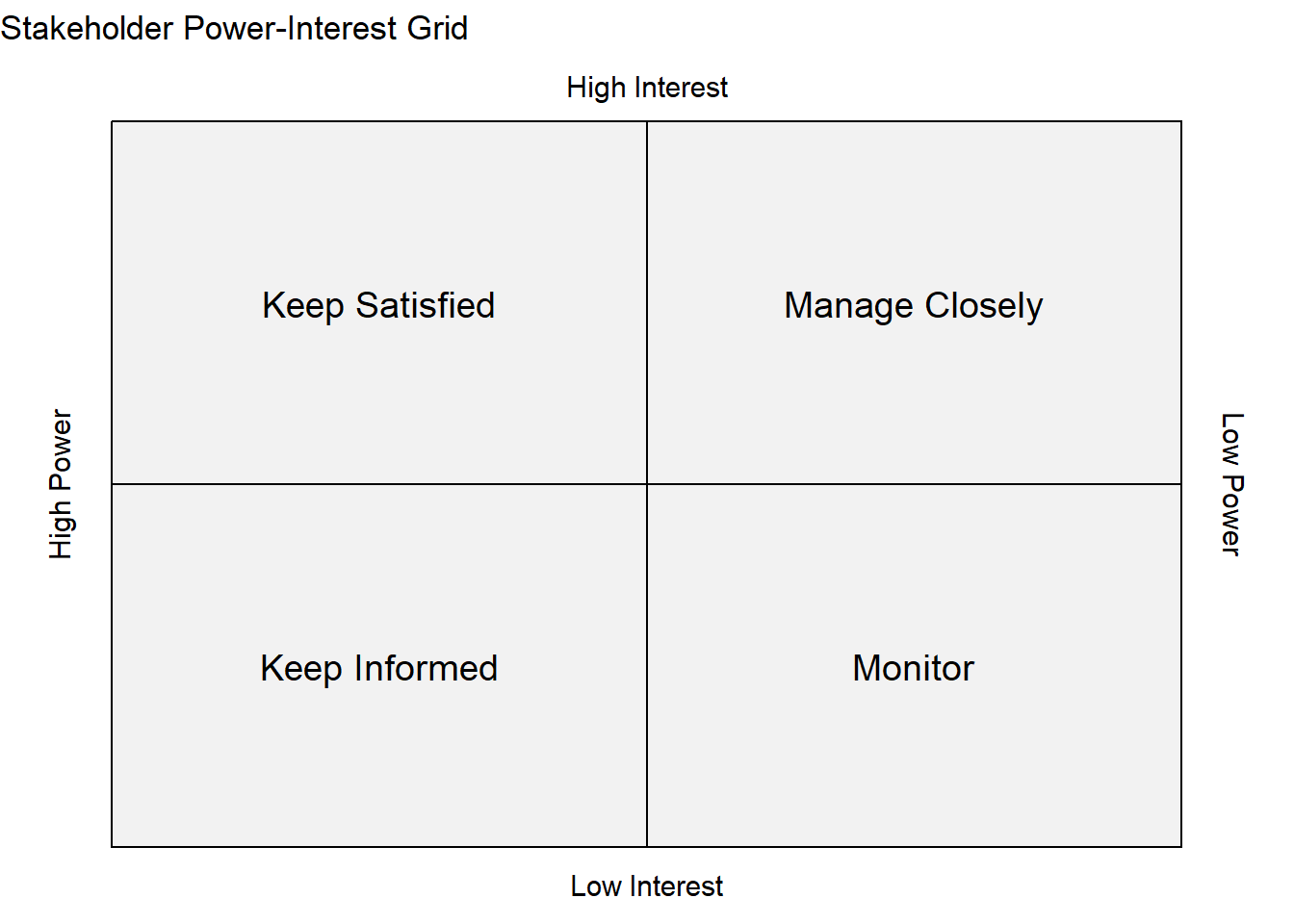
Stakeholder mapping using a Power/Interest Grid
Develop a formal communication plan detailing
- What, when, how, and by whom
Proactive communication is key to preventing problems
Maintain realistic expectations
- Manage scope and trade-offs
- Be upfront about scope, time, cost
- When a new request comes in, immediately ask: “Which of the current priorities will this replace?”
- Under-promise and over-deliver
- Set a realistic baseline, then exceed it (if possible)
- Never promise what you can’t guarantee
- Address issues early
Leading Teams Through Uncertainty
“What you are afraid of is never as bad as what you imagine. The fear you let build up in your mind is worse than the situation that actually exists.”
- Haw, Who Moved My Cheese (Johnson 2002)
The Psychology of Change
The classic business parable by Dr. Spencer Johnson offers a simple framework for understanding reactions to organizational and market uncertainty (Johnson 2002)
- The “Cheese”: Represents what people want
- Stable job
- Successful project
- Certain salary
- Defined strategy
- Predictable environment
- Loss of cheese = Loss of stability
- The “Mice” (Sniff & Scurry)
- Proactive members who recognize change early and act quickly
- They don’t overanalyze
- They move toward the “New Cheese”
- Lesson for Leaders
- Identify and empower your “Sniffers and Scurriers”
- Team members who embrace new methodologies, adapt easily, or are early adopters
- The “Little People” (Hem & Haw)
- These characters struggle with change
- Hem denies the change, leading to paralysis
- Haw eventually accepts the change and learns to adapt
- Lesson for Leaders
- Acknowledge that hesitation (Hem) is a natural reaction
- The goal is to facilitate the shift to adaptation (Haw) by reducing fear and illustrating the path forward
Encourage your team to
- “Smell the Cheese Often” (i.e. constantly assess the environment) so they aren’t surprised when the market shifts
- Take a step back and evaluate before panicking when change comes knocking
Reassuring a technical team amid uncertainty
When external forces are chaotic, the technical leader’s primary job is to create a stable, predictable environment for their team (Vignos 2017; Armeli 2025).
Focus on the controllable
- Shrink the horizon
- Focus only on the next 1-2 sprints or weeks of work
- Meet immediate, defined targets, not solve all global uncertainty
- Define “Success Today”
- Reiterate the immediate, concrete value of the work they are doing
- Example: “Our success is shipping this feature cleanly, regardless of what’s happening in the news.”
Enhance communication (transparency and cadence)
- Increase frequency, decrease length
- Hold more frequent, shorter huddles (e.g. quick 15-minute afternoon syncs)
- Prevents anxiety from building up between meetings
- Be a filter, not a conduit
- Don’t relay every piece of executive rumor or speculation
- Filter the noise and provide only actionable, confirmed information relevant to their work
- Be honest about the unknown
- It’s better to say, “I don’t know yet, but I will update you by 3 PM,” than to offer false reassurances or avoid the question.
Protect psychological safety
- Normalize Fear
- Acknowledge that the uncertainty is stressful (e.g. “I know the market volatility is distracting, and that’s okay”)
- Validates feelings and reduces the need for destructive emotional coping
- Defend focus time
- Protect the team from excessive interruptions that burn energy and reduce the feeling of control
- All hands meetings
- Urgent data requests
- Unnecessary context-switching
- Protect the team from excessive interruptions that burn energy and reduce the feeling of control
Reinforce Core Purpose
- Connect work to mission amid
- Shifting strategy
- Market uncertainty
- Reinforce and recognize the value of their underlying technical skills, e.g.
- Building reliable systems
- Writing clean code
- Solving complex problems