8 Project Initiation & Success
Acknowledgements
Creation of these notes included brainstorming and proof reading with Gemini.
Introduction
Last week, we explored some challenges and unique properties of technical projects. This week, we’re getting to the heart of project management:
- Turning an idea into an executable project
- Setting our project up for success
The Project Charter
- A formal (short) document establishing
- High level project parameters
- Authority to initiate the project
A typical Project Charter includes:
Project title and purpose: What’s the project’s name, and why are we doing this?
Project manager: Who is authorized to lead the project?
Business case: A concise explanation of the business need or problem the project addresses.
High-level objectives and goals: What are we trying to achieve?
High-level scope: A broad overview of what’s in and out of the project.
Key stakeholders: Who are the key people or groups affected by or interested in the project?
High-level budget and resources: A rough estimate of the money and people needed.
Success Criteria: What will “done” look like? How do we know we’ve succeeded?
Why is a project charter important? The charter:
- Creates alignment
- Ensures that sponsors, managers, and the team all agree on the project’s purpose and scope before any real work begins
- Prevents scope creep from day one by establishing a clear baseline
Stakeholders
A project doesn’t exist in a vacuum. It impacts people, and people impact the project.
- Stakeholder: anyone with an interest in or influence over the project, including
- Team members
- Customers
- Executives
- Investors
- Government regulators…
Effective stakeholder management is critical to project success. If you ignore your stakeholders, you risk
- Building something nobody wants
- Wasting time and money
- Having your project killed
Power-Interest grid
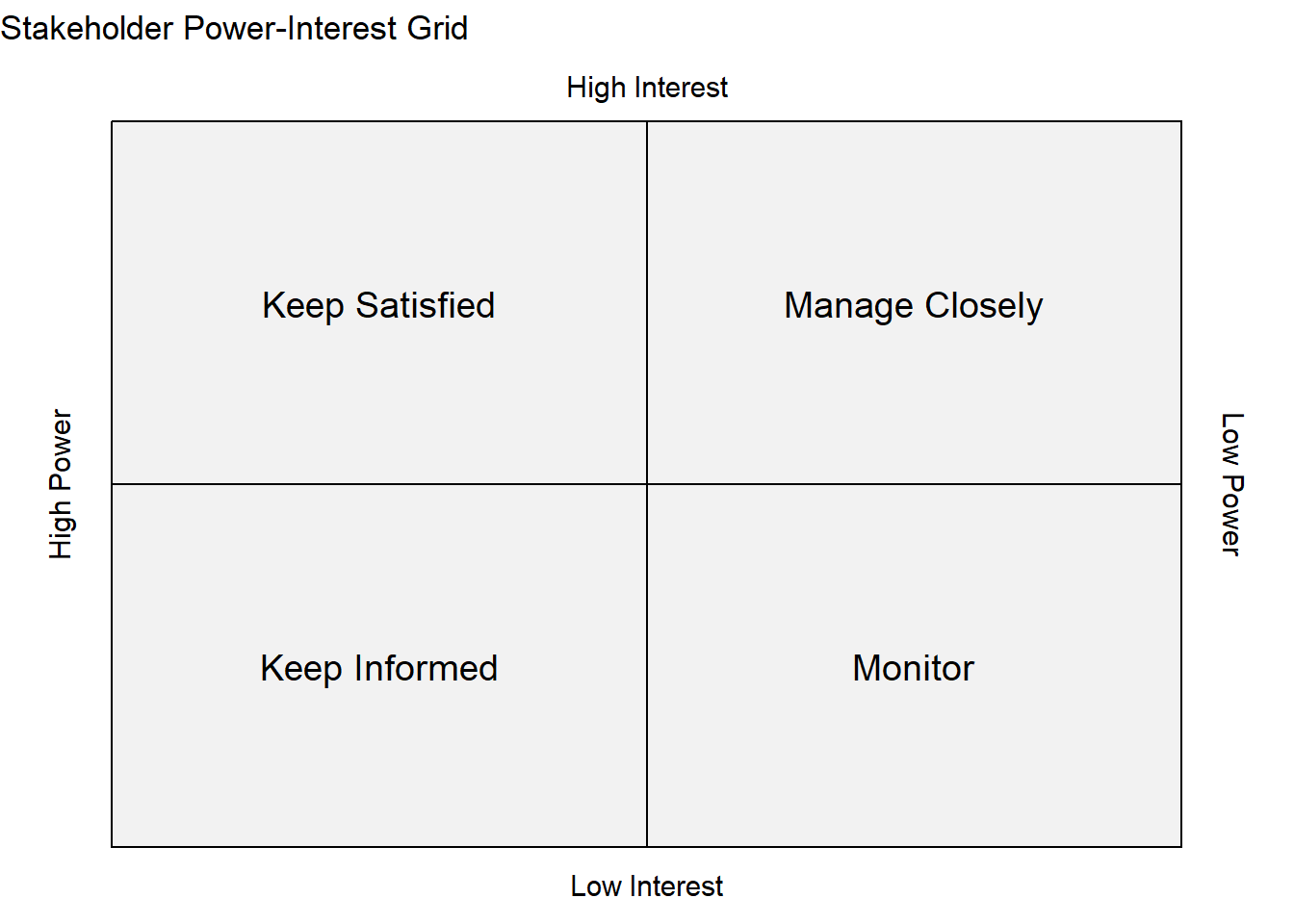
We can analyze stakeholders using a power-interest grid.
- High Power, High Interest (Manage Closely): These are your key players. They have the most influence and are highly invested. You need to keep them engaged, informed, and satisfied.
- High Power, Low Interest (Keep Satisfied): These stakeholders can shut down your project, but they aren’t actively involved. Provide them with regular, concise updates to prevent them from becoming an obstacle.
- Low Power, High Interest (Keep Informed): They might not have decision-making power, but they are very interested in the project. Keep them in the loop and leverage them as allies.
- Low Power, Low Interest (Monitor): These people have minimal influence and low interest. Don’t waste too much time or resources on them, but keep an eye on them in case their status changes.
By systematically identifying and analyzing your stakeholders early, you can proactively manage their expectations and build the necessary relationships for success.
Defining Project Success: Objectives and KPIs
How do you know if you’ve succeeded? Can we just say
- Yay, we launched the product!?!
We need a more rigorous, objective definition of success
- Measurable objectives: goals or milestones along the path to your finished product
- Key Performance Indicators (KPIs): based on a metric and includes a target for that metric
SMART objectives
A common framework for setting objectives is the SMART criteria:
Specific: The goal must be clear and well-defined. (e.g. Instead of “make the app faster,” say “reduce the average page load time by 50%.”)
Measurable: You must be able to quantify the success of the goal. How do you know when you’ve achieved it?
Achievable: Is the goal realistic given your resources and constraints?
Relevant: Does the goal align with the overall business objectives and the project’s purpose?
Time-bound: There must be a deadline or a specific timeframe for completion.
Key Performance Indicators (KPIs)
Project objectives and KPIs are directly tied to each other.
- Project objectives: what are you trying to achieve?
- KPIs: what is our progress toward those objectives?
TipKPI’s have two components
- A metric that we can measure
- A target tied to the success of one or more objectives
Some KPIs you might be good for a technical project include:
Time to Market: How long did it take to launch the product?
User Adoption Rate: What percentage of users are actively using the new feature?
Bug Count: The number of critical bugs found post-launch.
Average issue response time: How long does it take to resolve new issues?
Uptime: The percentage of time the service is operational.
Customer satisfaction score: A measure of how happy customers are with the new product or feature.
Defining success is a crucial step in the initiation phase because it sets a common understanding for what matters and provides a clear way to evaluate the project’s progress and ultimate outcome.
Further reading
Here are a few blog posts you can read for additional insights: